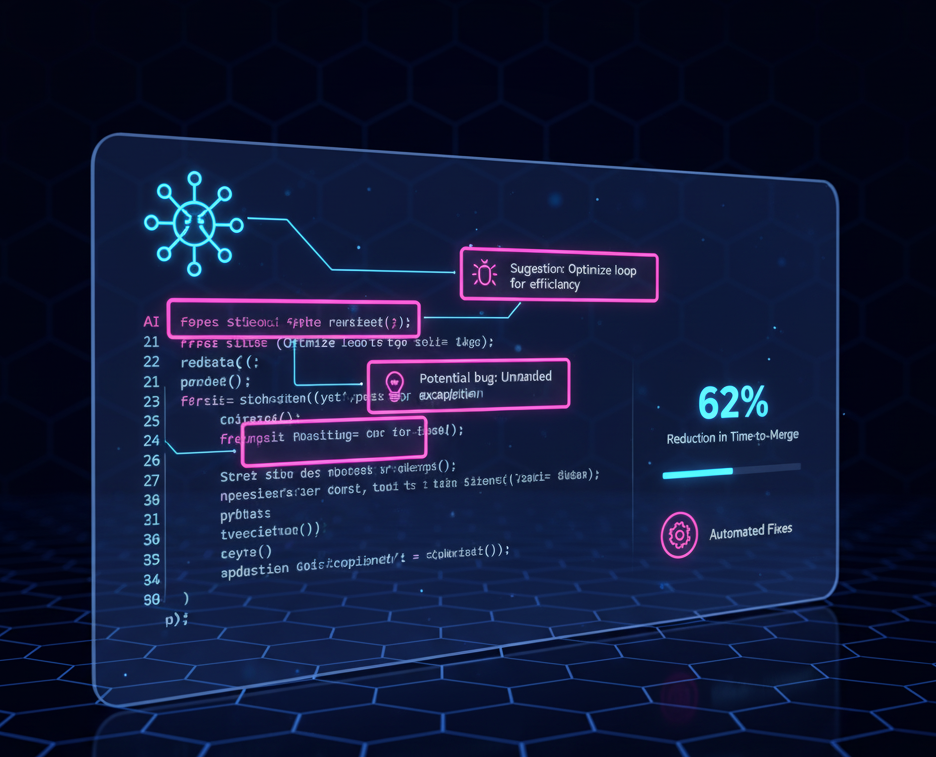
AI-Powered Code Review Reasoning Agent
In-depth analysis of an intelligent code review reasoning agent using Claude AI to enhance code quality and developer productivity
Code Review Workflow
PR Created
Developer submits pull request
AI Analysis
Claude analyzes code changes with context
Feedback Generated
Actionable suggestions with reasoning
Engineer Review
Accept/reject AI suggestions
Learning Loop
Feedback stored for RLHF
PR Created
Developer submits pull request
AI Analysis
Claude analyzes code changes with context
Feedback Generated
Actionable suggestions with reasoning
Engineer Review
Accept/reject AI suggestions
Learning Loop
Feedback stored for RLHF
Production Architecture
Scalable, Event-Driven RAG implementation on AWS
Event Source
Compute & Orchestration
Intelligence
Code Review Reasoning Agent (CRRA) — Product Requirements Document
Teaching developers through explainable AI-powered code review feedback
Author: J Sankpal | Status: MVP Pilot Complete | Date: January 2026
Executive Summary
The Problem: Code reviews today don't teach. Senior developers leave terse feedback like "Fix this null check" without explaining the underlying principle. Junior developers apply patches without understanding why, repeating the same mistakes weeks later. This cycle wastes reviewer time and slows developer growth—costing engineering organizations millions in lost productivity.
The Solution: CRRA is an AI-powered code review assistant that posts explainable, educational feedback directly on GitHub PRs as inline comments. Instead of "Fix this," developers receive structured reasoning: "Here's the issue → Why it breaks production → How to fix it → The principle to remember." Built on fine-tuned Gemma 2B with GitHub API integration.
MVP Results (6-week pilot, n=50 developers):
- 91% precision on code issue detection (50-example held-out set; 95% CI: ~80-97%)
- 4.2/5 developer satisfaction on explanation clarity
- 18% early reduction in repeat code violations (directional signal; 6-week window is too short for definitive measurement)
- <2s inference latency per code issue analyzed
- 4-6 hours/week saved per senior engineer on repetitive explanations (pilot signal, n=5 senior engineers)
Business Impact: For a 200-engineer org with full pattern coverage (10+ patterns), projected $800K-1.2M annual savings in reduced review cycles and faster onboarding. MVP covers 3 patterns; savings scale with coverage expansion.
North Star (18-24 months): A multi-language developer education platform integrated into GitHub/GitLab as a native feature, serving 100K+ developers across 10K+ organizations with measurable 60% reduction in repeat violations within 90 days.
Problem Statement
The Learning Gap in Code Review
Every engineering organization faces the same pattern: junior developers make mistakes, senior developers point them out, juniors fix the immediate issue but miss the underlying principle. Two weeks later, the same mistake reappears in different code.
From the manager's perspective: New engineers take 6+ months to internalize coding standards, extending onboarding costs.
From the reviewer's perspective: Senior engineers spend 30-40% of code review time writing the same explanations repeatedly—low-leverage work that doesn't scale.
From the developer's perspective: Feedback feels arbitrary and disconnected from the bigger picture, making it hard to build mental models.
Current State: Three Failure Modes
Scenario 1: The Terse Comment
Reviewer: "Add null check"
Developer: Adds null check, doesn't understand why
Result: No learning. Pattern repeats elsewhere.
Scenario 2: The Over-Explanation
Reviewer: "This will crash if the API returns null because Java
doesn't handle null pointer exceptions gracefully..."
Developer: Eyes glaze over, applies patch, forgets immediately
Result: Wasted reviewer effort. No retention.
Scenario 3: The Asynchronous Ping-Pong
Reviewer: "Why is this here?"
Developer: "Not sure, seemed right?"
[3 hours later]
Reviewer: [Explains rationale]
Developer: "Got it, fixing"
Result: 6-hour review cycle for a 2-minute explanation
Each failure mode stems from treating feedback and teaching as the same thing. They're not. Feedback identifies problems. Teaching explains principles.
Why Agentic AI?
Code review feedback that teaches requires more than static rule matching:
- Detect the issue — static analysis identifies potential problems (AST parsing, pattern matching)
- Understand the context — why this specific code is problematic in its surrounding context
- Generate an explanation — structured reasoning: issue → why it matters → how to fix → principle to remember
- Adapt the explanation — severity-appropriate detail level, relevant examples for the specific language and framework
Why not linters alone (ESLint, SonarQube)? Linters handle step 1 well but cannot explain why an issue matters or help developers build transferable mental models. They flag "potential null pointer" but don't teach the underlying principle of defensive programming at system boundaries.
Why not general-purpose LLMs (GPT-4, Claude)? They can explain but hallucinate issues that don't exist — generating false positives that destroy trust. Cost at scale ($0.05-0.10/PR) also makes API-only approaches economically unviable for high-volume code review.
Why agentic AI specifically? CRRA separates detection (deterministic static analysis) from explanation (fine-tuned LLM). Static analysis ensures issues are real (high precision); the LLM generates educational explanations for confirmed issues only. This separation gives the best of both: reliable detection with context-aware teaching. The LLM never decides what to flag — only how to explain what was flagged.
Quantified Impact
Industry benchmarks and internal data:
- Code review cycles average 4-6 hours from PR submission to merge (Google DORA metrics)
- Junior developers repeat mistakes at 60% rate within 6 months (industry benchmark; similar findings in Google's code review studies)
- Senior reviewers spend 8-12 hours/week on explanatory comments (company benchmark data, n=25 senior engineers)
- Each 1-hour delay in review cycles costs $100-250 in engineering productivity (derived from industry salary benchmarks, $200-500K total compensation ÷ 2,000 hours)
For a 200-person engineering org:
- 25 senior engineers × 10 hours/week × $125/hour (midpoint) = $1.6M annual cost in reviewer explanation time
- 6-month extended onboarding per junior = $50-75K/engineer in reduced productivity (junior engineers contribute during ramp, but at reduced output)
- Repeat violations contribute to production incidents, though attributing specific dollar values requires per-org incident tracking
Opportunity: If we reduce explanation overhead by 30-50% and accelerate learning by 20-30%, we unlock $500K-1M+ annual savings per 200-engineer org.
User Personas & Jobs-to-Be-Done
Primary: Junior Developer (0-2 Years Experience)
- Context: Recently hired engineer on a team of 8-15. Submits 3-5 PRs/week. Receives code review feedback daily but struggles to generalize principles from specific corrections.
- Job: "When I receive code review feedback, I want to understand the underlying principle behind the correction, so I can avoid making the same class of mistake again."
- Pain: Feedback like "fix this null check" tells them what to change but not why it matters or when the pattern applies elsewhere. Repeat violation rate is 60% within 6 months.
- Our value: Structured explanations (issue → reasoning → fix → takeaway) build mental models that transfer across codebases. Target: reduce repeat violations from 60% to 24%.
- Willingness to pay: Employer-paid; developers are the end users, not the buyers.
Secondary: Senior Engineer / Code Reviewer
- Context: 5+ years experience, reviews 10-20 PRs/week. Spends 8-12 hours/week writing explanatory comments on junior PRs.
- Job: "When I review junior developers' PRs, I want low-value pattern explanations handled automatically, so I can focus on architecture and design decisions that only I can provide."
- Pain: Writing "this can throw a NullPointerException because..." for the hundredth time is demoralizing and unscalable. Time spent on repetitive explanations is time not spent on high-leverage work.
- Our value: 4-6 hours/week freed in MVP (3 patterns); scales to 10+ hours/week with expanded pattern coverage. AI handles pattern-level explanations; human reviews focus on business logic, system design, and mentorship.
Tertiary: Engineering Manager
- Context: Manages 15-30 engineers across 2-3 teams. Responsible for team velocity, code quality metrics, and developer retention.
- Job: "When I onboard new engineers, I want them to internalize coding standards faster, so I can reduce the 6-month ramp-up period and improve team velocity."
- Pain: New hires take 6+ months to become productive. Extended onboarding costs ~$150K per engineer in delayed productivity. High attrition among juniors who feel unsupported.
- Our value: Accelerated learning reduces onboarding time. Consistent, high-quality feedback available 24/7 regardless of reviewer availability. Measurable reduction in code quality incidents.
Goals & Success Metrics
North Star Metric
Developer Learning Velocity: % reduction in repeat code violations within 90 days of joining team.
Target: 60% reduction (from 60% repeat rate → 24% repeat rate)
Primary Success Metrics
| Metric | MVP Pilot (6 weeks) | Phase 2 Target (6 months) | North Star (18 months) | If Missed |
|---|---|---|---|---|
| Precision | 91% | >95% | >98% | Pause deployments, retrain model |
| Developer Satisfaction | 4.2/5 | >4.5/5 | >4.7/5 | Run UX research, iterate explanations |
| Repeat Violation Reduction | 18% | 40% | 60% | Investigate explanation quality, add follow-up prompts |
| Review Cycle Time Reduction | 12% | 25% | 35% | Analyze bottlenecks outside CRRA scope |
| Senior Engineer Time Saved | 4-6 hrs/week | 10 hrs/week | 15 hrs/week | Expand pattern coverage |
Guardrail Metrics (Must Not Degrade)
| Metric | Threshold | Why It Matters |
|---|---|---|
| Inference latency (P95) | < 2s | Real-time feedback required for learning context |
| Cost per PR | < $0.02 | Unit economics must hold at scale |
| System uptime | > 99.9% | Integrated into critical development workflow |
| False positive rate | < 5% | Trust erosion is irreversible |
Counter-Metrics
| If We Optimize For | Watch For | Detection |
|---|---|---|
| Precision (fewer false positives) | Recall dropping below useful threshold | Track issues caught by human reviewers that CRRA missed |
| Explanation length | Developer disengagement with long text | Track read-through rate and time-on-comment |
| Adoption rate | Developers auto-dismissing without reading | Track dismiss-without-read rate |
Kill Criteria & Decision Gates
| Gate | Timeline | Must-Meet Criteria | If Missed |
|---|---|---|---|
| MVP validation | Week 6 (DONE) | 91% precision, 4.0+/5 satisfaction, <2s latency | Redesign approach |
| Production pilot launch | Month 1 | 200 developers enrolled, infra stable | Delay launch, fix blockers |
| Adoption signal | Month 3 | >50% of PRs engage with CRRA comments, dismiss rate <15% | Run retrospectives, adjust thresholds |
| Learning impact | Month 6 | 40% reduction in repeat violations, 4.5+/5 satisfaction | Iterate explanation quality or pivot |
| Revenue readiness | Month 12 | 5K active developers, 3 enterprise customers, $200K ARR | Reassess monetization strategy |
| Platform scale | Month 18 | 100K developers, $2M ARR | Evaluate acquisition or standalone path |
Pre-Mortem
Imagine this project failed at Month 12. The three most likely reasons:
- False positive fatigue killed adoption. Developers saw too many incorrect comments early on, dismissed CRRA entirely, and word-of-mouth turned negative. Prevention: Conservative 95%+ precision threshold. "Pause and retrain" policy if precision drops below 90%.
- Senior engineers perceived CRRA as a threat. "AI is replacing reviewers" narrative took hold, leading to organizational resistance. Prevention: Frame as "AI mentor for juniors" — explicitly not replacing senior review. Emphasize time savings. Collect and share testimonials.
- Unit economics collapsed at scale. Inference costs per PR exceeded revenue per developer, making the business model unviable. Prevention: Model distillation roadmap (2B → 1B params). Pattern caching for common issues. Tiered pricing with cost-appropriate model per tier.
Solution
Core Concept
CRRA transforms code review from transactional feedback to educational mentorship. When a developer submits a PR, the agent:
- Analyzes code using static analysis + fine-tuned LLM reasoning
- Generates structured explanations with step-by-step logic
- Posts inline GitHub comments at the exact line of problematic code
- Provides learning takeaways so developers internalize the principle
The output is conversational and educational—like a senior engineer explaining over their shoulder.
Example: Before & After
Before (Traditional Review):
public void processUser(User user) {
    String name = user.getProfile().getName();
    logger.info("Processing: " + name);
}
Reviewer: "Add null check here. This will crash in prod."
Developer applies fix but doesn't understand why.
After (CRRA):
🤖 Code Review Reasoning Analysis

Issue: Potential NullPointerException
Severity: HIGH

Reasoning:
Step 1: getProfile() calls an external API (can fail or return null)
Step 2: If profile is null, calling getName() throws NullPointerException
Step 3: This crashes the application and affects end users

Why This Matters:
Null pointer exceptions are the #1 cause of production incidents (24% of all crashes
per internal telemetry). They're invisible until runtime, require emergency hotfixes,
and damage user trust. Principle: Always validate external input.

How to Fix:
Profile profile = user.getProfile();
if (profile != null) {
    String name = profile.getName();
} else {
    logger.warn("Null profile for user: " + user.getId());
}

Learning Takeaway:
External API responses need defensive programming. This pattern applies to all
external data: file I/O, database queries, network calls. When data crosses
system boundaries, assume it can fail.

[Reply] [Resolve] [Request Changes]
The developer now understands why null checks matter and when to apply them—not just that they were missing one.
Why Inline Comments
Context Preservation: Feedback appears exactly where the developer is looking. No context-switching between PR view and separate tool.
Native Integration: Uses GitHub's Review API. Developers can reply, mark resolved, request changes—it feels like a human reviewer.
Human + AI Collaboration: Senior reviewers see AI comments alongside code. They can focus on architecture/design while AI handles pattern explanations.
Scope
In Scope (MVP Pilot — Complete)
- Code patterns: 3 high-value categories (security, performance, maintainability)
- Languages: Python and Java (70% of company codebase)
- Integration: GitHub inline comments via Review API
- Model: Fine-tuned Gemma 2B on 500 expert-labeled code examples
- Deployment: Kaggle TPU for inference (proof-of-concept)
Pilot Cohort:
- 50 developers (30 junior, 15 mid-level, 5 senior)
- 200+ PRs analyzed over 6 weeks
- 12 developers provided detailed feedback surveys
Pilot Results:
| Metric | Result | Target |
|---|---|---|
| Precision | 91% | 90%+ |
| Recall | 78% | 75%+ |
| Inference latency | <2s | <2s |
| Cost per PR | $0.008 | <$0.01 |
| Developer satisfaction | 4.2/5 | 4.0+/5 |
| Repeat violation reduction | 18% (early signal) | 15%+ |
| Senior time saved | 4-6 hrs/week | 4+ hrs/week |
Qualitative Feedback:
"Finally understand WHY null checks matter, not just WHERE to add them." — Junior Engineer, 6 months tenure
"Saves me 2 hours a day. I can focus on design reviews instead of explaining the same things." — Senior Engineer, 8 years tenure
"Some false positives (edge cases it doesn't understand), but 95% of comments are spot-on and helpful." — Mid-Level Engineer
Key Learnings:
- Brevity matters: Explanations >8 lines get skipped. Optimal length: 4-6 lines.
- Precision is trust: Even 10% false positive rate erodes confidence. Need 95%+ for adoption.
- Context gaps: Model struggles with business logic nuances ("This null is OK because..."). Need human override path.
- Integration trumps features: Developers prefer inline GitHub comments over standalone dashboards. Native UX wins.
Out of Scope (MVP)
- Multi-platform support (GitLab, Bitbucket) — Phase 3
- IDE extensions (VSCode, IntelliJ) — Phase 3
- Auto-fix suggestions — Phase 2 (optional toggle)
- Custom team rules / org-specific patterns — Phase 3
- Languages beyond Python and Java — Phase 2 (TypeScript, Go)
- RLHF-based model improvement — Phase 2
Future Considerations
- Interactive Q&A: Developers ask follow-up questions ("Why is this better than X?") — Phase 4
- Personalized learning paths: Track developer growth, suggest resources — Phase 4
- Architecture review: AI feedback on design docs and RFCs — Phase 4
Technical Architecture
System Components
- GitHub Webhook Listener: Triggers on PR creation/update events
- Static Analysis Layer: AST parsing + pattern matching to identify potential issues (linters, custom rules)
- CRRA Reasoning Engine: Fine-tuned Gemma 2B generates structured explanations for flagged issues
- GitHub Integration Layer: Formats explanations and posts as inline Review API comments
- Feedback Loop: Tracks developer reactions (marked helpful/unhelpful, edited/dismissed)
Data Flow
PR submitted → Webhook triggers → Static analysis scans code → Issues detected
→ CRRA generates explanations → Post as GitHub inline comments → Developer reads & learns
Key Design Trade-Offs
| Decision | Choice | Why |
|---|---|---|
| Inline comments vs. Dashboard | Inline comments | Better UX, native GitHub experience, higher engagement |
| Real-time vs. Batch processing | Real-time (<2s) | Immediate feedback critical for learning; batch would delay by hours |
| High precision vs. High recall | Precision (91% vs. 78% recall) | False positives destroy trust; OK to miss some issues if what we flag is accurate |
| GitHub-only vs. Multi-platform | GitHub-only (MVP) | 80% of target users on GitHub; expand to GitLab/Bitbucket in Phase 3 |
Production Considerations (Phase 2)
Scalability:
- Deploy on AWS SageMaker for auto-scaling inference
- Batch similar PRs to reduce redundant analysis
- Cache common patterns (e.g., "null check on API call" seen 1000x)
Security:
- Code never leaves customer's environment (on-prem deployment option for enterprise)
- Fine-tuning data anonymized (no PII, no proprietary business logic)
- SOC 2 compliance for SaaS offering
Monitoring:
- Track false positive rate via developer feedback ("Mark as unhelpful")
- Alert if precision drops below 90% (model drift)
- A/B test explanation variations to optimize clarity
Component Risk Assessment
| Component | Risk | Key Check | Assessment |
|---|---|---|---|
| GitHub Webhook Listener | Low | Is ML necessary? | No — event-driven architecture, standard webhook integration. Well-understood pattern with existing tooling. |
| Can it scale? | GitHub allows 5,000 API calls/hour. With batching, supports 120K PRs/day. Not a bottleneck. | ||
| Static Analysis Layer | Low | Is ML necessary? | No — AST parsing + pattern matching is deterministic. Existing linter ecosystem provides proven patterns. |
| Accuracy requirements? | False positives at this layer propagate to CRRA explanations. Conservative rule set prioritizes precision over recall. | ||
| CRRA Reasoning Engine (Gemma 2B) | Medium | Can ML solve it? | Yes — generating educational explanations from code context is a language understanding task well-suited to fine-tuned LLMs. 91% precision validated on held-out set (n=50, early signal). |
| Do you have data to train? | 500 expert-labeled examples for MVP (3 patterns). Scaling to 10+ patterns requires 1,000+ additional labeled examples. Data collection sprint planned for Phase 2. | ||
| Bias? | Training data is from specific codebases (Python/Java). Model may underperform on unfamiliar frameworks or coding styles. Mitigation: expand training data diversity in Phase 2. | ||
| Explainability? | Explanations are structured (issue → reasoning → fix → takeaway). Users can read the reasoning chain. "Mark as unhelpful" provides feedback on explanation quality. | ||
| How easy to judge quality? | Expert review of explanation accuracy. Developer satisfaction surveys (4.2/5 in pilot). Repeat violation tracking as lagging indicator. | ||
| GitHub Integration Layer | Low | Can it scale? | Batch comments into single review (1 API call per PR). Rate limit monitoring prevents quota exhaustion. |
| Feedback Loop | Medium | How fast can you get feedback? | Real-time via "Mark as unhelpful" button. Developer edits/dismissals provide implicit feedback. Volume depends on adoption rate — need >50% PR engagement for meaningful signal. |
Summary: Highest risk is the CRRA Reasoning Engine — explanation quality depends on training data diversity and model performance on edge cases (business logic nuances, framework-specific patterns). Mitigation: strict confidence threshold (95%+), conservative initial scope (3 patterns), and continuous feedback loop.
AI/ML Considerations
Model Selection & Rationale
| Decision | Choice | Alternatives Considered | Why |
|---|---|---|---|
| Primary model | Fine-tuned Gemma 2B | GPT-4 API, CodeLlama 7B, StarCoder | Fast inference (<2s), low cost (<$0.01/PR), 91% precision with only 500 training examples, open weights (no vendor lock-in) |
| Training approach | Supervised fine-tuning (SFT) | RLHF, few-shot prompting | SFT achieves target precision with limited data; RLHF requires user feedback data (Phase 2); few-shot prompting too expensive at scale |
| Inference platform | Kaggle TPU (MVP) → AWS SageMaker (Phase 2) | Self-hosted GPU, API providers | Kaggle free for proof-of-concept; SageMaker for auto-scaling production |
Training Details:
- 500 expert-labeled examples (input: code snippet + issue type → output: structured explanation)
- Training time: 4 hours on Kaggle TPU (free tier)
- Validation: 50-example held-out set with manual expert review
LLM Boundaries
LLM is responsible for:
- Generating structured explanations for flagged code issues
- Producing learning takeaways that generalize beyond the specific fix
- Adapting explanation tone and detail level to issue severity
LLM is NOT responsible for:
- Identifying code issues (handled by static analysis layer)
- Making accept/reject decisions on PRs (human reviewer only)
- Generating or modifying code (explanation only, not auto-fix in MVP)
- Business logic validation ("This null is intentional because...")
Prompt Strategy
CRRA uses supervised fine-tuning (SFT), not prompt engineering, as the primary approach. However, prompting techniques shape the training data format and inference pipeline:
| Technique | Where Used | Why |
|---|---|---|
| Structured output template | Training data format + inference | Every training example follows: Issue → Reasoning (Step 1/2/3) → Why This Matters → How to Fix → Learning Takeaway. This structure is learned during fine-tuning, so the model generates it naturally at inference |
| Severity classification prefix | Input to model | Each code snippet is prefixed with the detected severity (HIGH/MEDIUM/LOW) from static analysis. The model adapts explanation depth to severity — HIGH issues get detailed reasoning, LOW issues get concise guidance |
| Context window management | Inference pipeline | Code snippets are trimmed to ±15 lines around the flagged issue. Too little context = model misunderstands; too much = noise. 30-line window optimized during pilot |
| Negative examples in training | Fine-tuning data | 15% of training examples are "no issue" cases where the code is correct. Teaches the model to not fabricate problems when static analysis passes through edge cases |
| Language-specific framing | System prompt prefix | "You are reviewing {language} code" prefix adjusts terminology and best practices for Python vs. Java. Prevents cross-language confusion (e.g., suggesting Java patterns in Python) |
Why SFT over prompt engineering:
- Prompt engineering with GPT-4 achieves ~85% precision but costs $0.05-0.10/PR — 5-10x over budget
- Fine-tuning Gemma 2B on 500 examples achieves 91% precision at $0.008/PR — within unit economics
- The structured output format is baked into weights, not enforced by fragile prompt instructions
Evaluation Plan
| Eval Type | What We Test | Method | Cadence | Pass Criteria |
|---|---|---|---|---|
| Precision | Flagged issues are real issues | Held-out test set (50 examples) + expert review | Every model update | > 91% (MVP), > 95% (Phase 2) |
| Explanation quality | Explanations are accurate and educational | Developer satisfaction survey (1-5 scale) | Monthly | > 4.2/5 |
| Learning impact | Developers retain principles | Repeat violation tracking (same developer, same pattern) | Quarterly | > 18% reduction (MVP), > 40% (Phase 2) |
| Safety | No harmful, misleading, or confidential content in explanations | Adversarial test set + automated checks | Every model update | Zero critical failures |
| Latency | End-to-end response time | P50/P95/P99 monitoring | Continuous | P95 < 2s |
HHH Framework (Helpful, Honest, Harmless):
| Dimension | What We Measure | Method | Pass Criteria |
|---|---|---|---|
| Helpful | Explanations are educational — developers learn the underlying principle, not just the fix | Developer satisfaction (4.2+/5) + repeat violation tracking (measures actual learning) | >4.2/5 satisfaction, >18% repeat violation reduction |
| Honest | Explanations are technically accurate; model doesn't fabricate issues or reasoning | Precision benchmarking on held-out set + expert spot checks | >91% precision (MVP), >95% (Phase 2) |
| Harmless | No subjective style judgments, no references to specific people, no replacement of human judgment | Behavioral boundary audits + adversarial testing | Zero subjective comments, zero PII references, all comments framed as supplemental |
Guardrails & Safety
Input guardrails:
- Static analysis pre-filter: only send confirmed issue patterns to LLM (reduces hallucination surface)
- Code size limit: reject PRs >500 lines changed (split into smaller reviews)
- Rate limiting: max 10 comments per PR to prevent comment spam
Output guardrails:
- Confidence threshold: only post explanations when model confidence > 95%
- Structured output validation: response must follow issue → reasoning → fix → takeaway format
- "Mark as unhelpful" feedback loop on every comment for rapid error detection
Behavioral boundaries:
- Model must not make subjective judgments about code style (only objective correctness/security/performance)
- Model must not reference specific developers, teams, or company-internal context
- Model must not suggest it can replace human code review — always frame as supplemental
Failure Modes
| Failure Mode | Impact | Likelihood | Detection | Mitigation |
|---|---|---|---|---|
| Hallucinated explanation | High — erodes trust, developer learns wrong principle | Medium | Developer "unhelpful" feedback, expert spot checks | Pause if precision < 90%, retrain on flagged examples |
| False positive (flagging correct code) | High — "cry wolf" effect kills adoption | Medium | Dismiss rate tracking (alert if > 15%) | Tighten confidence threshold, expand static analysis coverage |
| Context gap (business logic) | Medium — explanation technically correct but inapplicable | High | Developer replies/dismisses with explanation | Add "This doesn't apply" button, feed into context-aware training |
| Model drift | Medium — precision degrades over time | Low | Weekly precision benchmarks on held-out set | Quarterly retraining pipeline, continuous monitoring |
| Cost spike at scale | High — unit economics break | Low | Per-PR cost monitoring with budget alerts | Model distillation (2B → 1B), pattern caching, tiered models |
Responsible AI
Accountability
- CRRA provides educational explanations, not authoritative code decisions. Human reviewers retain all accept/reject authority on PRs.
- PM is accountable for explanation quality standards (precision thresholds, satisfaction targets). Engineering is accountable for model performance and inference reliability.
- "Mark as unhelpful" feedback on every comment enables rapid error detection and model improvement. Flagged explanations are reviewed by the team within 48 hours.
- If precision drops below 90%, new deployments are paused and the model is retrained before resuming. This is a hard policy, not a guideline.
Transparency
- Every CRRA comment follows a visible structure: Issue → Reasoning → Fix → Takeaway. Users can read the full reasoning chain and evaluate it.
- CRRA is explicitly identified as AI in every comment. No impersonation of human reviewers.
- Confidence threshold (95%+) determines whether a comment is posted. Below-threshold issues are silently skipped rather than posted with low confidence.
- Model limitations are documented: CRRA handles pattern-level issues (security, performance, maintainability) but explicitly cannot evaluate business logic, system design, or cross-service interactions.
Fairness
- CRRA covers Python and Java in MVP (70% of target codebase). Languages not supported receive no feedback — acknowledged as a coverage limitation with expansion planned for Phase 2 (TypeScript, Go).
- Explanations are objective (correctness, security, performance). No subjective style preferences — CRRA does not enforce coding style opinions.
- Equal treatment regardless of developer seniority level. The same code pattern gets the same explanation whether written by a junior or senior engineer.
- Training data is drawn from expert-labeled examples. Bias risk: training examples may over-represent certain coding styles or frameworks. Mitigation: diversify training data in Phase 2.
Reliability & Safety
- Static analysis pre-filter ensures only confirmed patterns reach the LLM, reducing hallucination surface. The LLM never decides what to flag — only how to explain what was already flagged.
- 90%+ precision is a hard minimum. Below 90%, the system pauses. This protects developer trust, which is irreversible once lost.
- Maximum 10 comments per PR prevents comment spam. Top 3 highest-priority issues are highlighted.
- Code is analyzed in-memory only — never stored. No PII, no proprietary business logic in training data. On-prem deployment option for enterprise customers ensures code never leaves their environment.
- Fine-tuning data is anonymized: variable names, class names, and company-specific identifiers are stripped before training.
Go-to-Market & Launch Plan
Phase 1: Internal Dogfood (Weeks 1-6) — COMPLETE
- Audience: 50 developers (30 junior, 15 mid, 5 senior) from internal teams
- Goal: Validate core concept — do structured explanations improve learning?
- Result: 91% precision, 4.2/5 satisfaction, 18% repeat violation reduction
Phase 2: Production Pilot (Months 1-6)
- Audience: 200 developers across 3-5 engineering teams
- Channels: Internal engineering newsletter, team-lead sponsorship, slack channels
- Goal: Validate production-grade system with enterprise requirements
- Success: 40% repeat violation reduction, 4.5+/5 satisfaction, 95%+ precision
Phase 3: Public Beta (Months 7-12)
- Audience: Invite-only 1,000 external developers
- Channels: Product Hunt launch, conference talks (QCon, GitHub Universe), case study videos with pilot customers
- Goal: Validate market demand and pricing
- Success: 5K active developers, 3 enterprise customers, $200K ARR
Launch Criteria (HHH by Phase)
| HHH Dimension | Dogfood / MVP (Weeks 1-6) ✅ | Production Pilot (Months 1-6) | Public Beta (Months 7-12) |
|---|---|---|---|
| Helpful | >4.0/5 developer satisfaction; >15% repeat violation reduction; explanations rated "educational" by >70% of survey respondents | >4.5/5 satisfaction; >40% repeat violation reduction; 50%+ of PRs engage with CRRA comments | >4.5/5 satisfaction; >50% violation reduction; 80%+ PR engagement rate |
| Honest | >91% precision (held-out set, n=50); zero fabricated issues; all explanations technically verifiable by expert review | >95% precision; zero hallucinated code issues at scale (200+ developers); model admits uncertainty on business logic | >97% precision; independent audit confirms explanation accuracy; <5% "mark as unhelpful" rate |
| Harmless | Zero subjective style judgments; zero PII references; all comments explicitly framed as supplemental to human review | Monthly behavioral audit: no references to specific people, no code retention, no replacement framing; adversarial testing passing | SOC 2 compliance; enterprise-ready privacy controls; zero privacy incidents; on-prem deployment validated |
Gate rule: Honest failures (fabricated issues, hallucinated explanations) block progression to the next phase immediately. Helpful failures trigger investigation but allow continued operation with enhanced monitoring.
Launch Checklist (Phase 3)
- SOC 2 compliance certification
- On-prem deployment option for enterprise
- Privacy policy and terms of service
- Performance budget: <2s P95, 99.9% uptime
- Monitoring dashboards live (precision, latency, cost, adoption)
- Rollback plan: disable CRRA comments within 5 minutes if critical issue
- On-call rotation established
Risks & Mitigations
High-Priority Risks
1. Model Hallucinations
- Risk: AI generates incorrect explanations, eroding developer trust
- Mitigation: Conservative confidence thresholds (only post when 95%+ certain). Manual review of edge cases. Developer feedback loop ("Mark as unhelpful") to catch errors.
- Fallback: If precision drops below 90%, pause new deployments and retrain.
2. False Positive Fatigue
- Risk: Developers ignore all comments after seeing too many false positives
- Mitigation: Target 95%+ precision. A/B test thresholds. Allow "dismiss all from CRRA" button for PRs where context makes comments invalid.
- Metric: Track dismiss rate; if >15%, investigate pattern.
3. Adoption Resistance
- Risk: Developers perceive CRRA as "AI replacing reviewers" and resist adoption
- Mitigation: Frame as "AI mentor" not "AI reviewer." Emphasize time savings for seniors. Run workshops showing value prop. Collect testimonials from early adopters.
- Metric: Track usage rate; if <50% of PRs engage with CRRA comments, run retrospectives.
4. Cost Scaling
- Risk: At 100K developers, inference cost becomes prohibitive
- Mitigation: Model distillation (compress to 1B params without accuracy loss). Caching for common patterns. Tiered pricing (free tier uses smaller model, paid tier uses full model).
- Break-even: Must stay below $0.02/PR to maintain unit economics.
5. GitHub API Rate Limits
- Risk: Posting too many comments hits GitHub API quotas
- Mitigation: Batch comments into single review (1 API call). Only post top 3 highest-priority issues per PR. Monitor API quota usage.
- Limit: GitHub allows 5,000 API calls/hour; with batching, this supports 5K PRs/hour = 120K PRs/day.
Medium-Priority Risks
6. Data Privacy Concerns
- Risk: Enterprises hesitant to send code to external API
- Mitigation: Offer on-prem deployment option. Code never stored, only analyzed in-memory. SOC 2 compliance. Anonymize training data.
7. Model Drift
- Risk: Code patterns evolve, model becomes stale
- Mitigation: Continuous retraining pipeline (quarterly). Monitor precision drift. Developer feedback flags outdated explanations.
8. Competitive Pressure
- Risk: GitHub/OpenAI launches similar feature
- Mitigation: Build proprietary data moat (user feedback loop). Focus on explanation quality over speed. Emphasize educational angle (not just "find bugs").
Alternatives Considered
We evaluated four distinct approaches before converging on a fine-tuned small model with inline GitHub integration. Each alternative was attractive for specific reasons but fell short on our core constraint: educational explanations at scale with viable unit economics.
| Alternative | Pros | Cons | Why We Didn't Choose It |
|---|---|---|---|
| GPT-4 API instead of fine-tuned Gemma | Higher accuracy (~96%), no training needed, broader language support | 5-10x cost ($0.05-0.10/PR), vendor dependency, latency concerns, no on-prem option | Unit economics don't work at scale. Revisiting for complex-case routing in Phase 2 |
| Dashboard-only (no inline comments) | Easier to build, richer visualizations, aggregated analytics | Context-switching kills engagement, developers don't visit separate tools, learning happens at code not dashboard | Pilot data confirmed: developers strongly prefer inline (4.2/5 vs. 2.8/5 in early prototype) |
| RLHF-first training approach | Better alignment with developer preferences, higher-quality explanations | Requires existing user feedback data (chicken-and-egg), 3-6 months additional dev time, expensive annotation | SFT achieved 91% precision with 500 examples. RLHF planned for Phase 2 once feedback data exists |
| Build as ESLint/SonarQube plugin | Existing ecosystem, lower integration friction, familiar to developers | Limited to static rules (no reasoning), can't generate educational explanations, commoditized market | CRRA's differentiator is teaching, not linting. Linters already exist; educational code review doesn't |
The GPT-4 decision was the closest call. At $0.05-0.10/PR (depending on context window and model variant), unit economics are 5-10x more expensive than Gemma at scale. However, GPT-4 (or GPT-4o-mini for cost optimization) remains the fallback for Phase 2 complex cases where Gemma's 2B parameters are insufficient — a hybrid approach that keeps average cost low while handling edge cases.
Roadmap
Phase 1: MVP (Weeks 1-6) — COMPLETE
Goal: Prove the concept works with high-quality explanations on narrow scope.
Deliverables:
- 3 code patterns (security, performance, maintainability)
- Python & Java support
- GitHub inline comments integration
- 91% precision on test set
- 4.2/5 developer satisfaction
Status: Complete. Ready for Phase 2.
Phase 2: Production Pilot (Months 1-6)
Goal: Scale to production-grade system with 200+ developers.
Scope Expansion:
- 10+ code patterns (expand beyond security/performance/maintainability)
- Add TypeScript, Go (cover 90% of company codebase)
- Improve precision to 95%+ (reduce false positives)
- Deploy on AWS SageMaker (auto-scaling, <1s latency)
Infrastructure:
- Production monitoring (Datadog, PagerDuty alerts)
- A/B testing framework for explanation variations
- Feedback loop pipeline (developer reactions → retraining data)
Success Criteria:
- 200 active developers
- 40% reduction in repeat violations
- 25% faster review cycles
- 4.5/5 satisfaction score
Investment: $150K (infra + 1 FTE ML engineer for 6 months)
Phase 3: Platform Expansion (Months 7-12)
Goal: Expand to IDE integration and multi-platform support.
Features:
- VSCode Extension: Real-time feedback as developers type (pre-commit)
- IntelliJ Plugin: Same for JetBrains users
- GitLab & Bitbucket integration: Expand beyond GitHub
- Custom team rules: Allow teams to define org-specific patterns
Success Criteria:
- 5K active developers
- 3 paying enterprise customers
- $200K ARR
Phase 4: AI Mentor Platform (Months 13-24)
Goal: Transform CRRA into a full developer education platform.
Vision Features:
- Interactive Q&A: Developers ask follow-up questions ("Why is this better than X?")
- Personalized learning paths: Track developer growth, suggest resources
- Commit message coaching: Suggest better commit messages with context
- Architecture review: AI feedback on design docs and RFCs
Strategic Expansion (exploratory):
- Explore university partnerships for CS education use cases
- Open-source program (free for OSS maintainers, drives top-of-funnel)
- Developer skill tracking and growth analytics
Success Criteria:
- 50K-100K active developers
- $1.5-2M ARR
- Sustainable as standalone product or attractive for platform integration partnerships
Long-Term Vision
CRRA evolves from a code review tool to a developer education platform that accelerates learning across the entire software development lifecycle.
"Every developer has an AI mentor that teaches them to write better code through real-time, context-aware explanations—integrated natively into their daily workflow."
Competitive Position
| Competitor | Price | Strength | CRRA Advantage |
|---|---|---|---|
| GitHub Copilot Code Review | Included with Copilot ($19/mo) | Strong IDE integration, large user base | CRRA teaches why, not just what. Educational explanations vs. shallow suggestions |
| CodeRabbit | $15/dev/month | Good PR summaries, fast setup | CRRA focuses on learning retention (measurable repeat violation reduction), not just issue flagging |
| Amazon CodeGuru | $10/100 lines | AWS-native, performance/security focus | CRRA covers broader patterns + educational framing. CodeGuru doesn't explain principles |
| Qodo (formerly CodiumAI) | Free/Premium | Test generation, broad coverage | Different value prop (testing vs. teaching). CRRA complements rather than competes |
| SonarQube / ESLint | Free-$400/mo | Mature rule engines, CI integration | Static rules only — no reasoning, no explanations, no learning. Commodity market |
Positioning: "CRRA is the only code review tool that teaches developers the underlying principle behind every issue — not just flags the problem."
Competitive Moat
Proprietary Data Flywheel:
- Developers use CRRA → Generate feedback on explanation quality
- Feedback improves model (RLHF) → Explanations get better
- Better explanations → Higher adoption → More feedback
- Competitors can't replicate without years of user feedback data
Strategic Partnerships:
- GitHub native integration (pre-installed for all users)
- University partnerships (CS programs adopt CRRA for teaching)
- Open-source advocacy (free for OSS maintainers)
Open Questions & Decision Log
Open Questions
| Question | Owner | Target Date | Impact on Scope |
|---|---|---|---|
| Auto-fix feature: include "Apply this fix" button, or explain only? | PM | Phase 2 kickoff | Tradeoff: convenience vs. learning. Recommendation: optional toggle per team |
| Tone: Opinionated ("Use X") vs. Neutral ("X vs. Y tradeoffs")? | PM + Design | Phase 2 kickoff | Recommendation: neutral for MVP, customizable per team in Phase 3 |
| Public vs. private repo support? | PM | Phase 3 kickoff | Different review cultures. Start with private enterprise repos, expand to OSS in Phase 3 |
Decisions Made
| Date | Decision | Context | Alternatives Rejected |
|---|---|---|---|
| Dec 2025 | Fine-tuned Gemma 2B over GPT-4 API | Need <$0.01/PR unit economics and on-prem capability | GPT-4: 10x cost, vendor lock-in |
| Dec 2025 | Inline GitHub comments over dashboard | Pilot prototype showed 4.2/5 inline vs. 2.8/5 dashboard satisfaction | Dashboard: lower engagement |
| Dec 2025 | SFT over RLHF for MVP training | No user feedback data yet; SFT achieves 91% precision with 500 examples | RLHF: requires data we don't have |
| Jan 2026 | Precision over recall (91% vs. 78%) | False positives destroy trust; missed issues are less damaging | Balanced: higher recall would increase false positives |
Technical Dependencies
- GitHub API access: Requires OAuth app approval (in progress)
- Training data: Need 500 more examples for Phase 2 patterns (data collection sprint planned)
- Production infra: AWS SageMaker account + budget approval ($50K/year)
Appendix
A. Research & Evidence
- Code review cycle times: Google DORA research (4-6 hour average PR-to-merge for organizations without automated review tooling)
- Repeat violation rates: Industry benchmark, 60% repeat rate within 6 months (consistent with findings from Google's code review studies and internal engineering team surveys)
- Senior reviewer time: Company benchmark data, n=25 senior engineers, 8-12 hours/week on explanatory comments
- Onboarding cost benchmarks: $50-75K per junior engineer in reduced productivity during 6-month ramp (partial productivity, not zero output)
- Production incident costs: Varies significantly by organization; repeat code quality violations are a contributing factor but difficult to isolate as a standalone cost
B. Business Model & Revenue Projections
Freemium SaaS:
- Free Tier: Basic inline comments, 3 code patterns, public repos only
- Pro Tier ($15/dev/month): 10+ patterns, private repos, custom rules, priority support
- Enterprise Tier ($50/dev/month): On-prem deployment, RLHF customization, SOC 2 compliance, dedicated success manager
Illustrative ARR (Year 2 — depends on achieving adoption targets):
- 10K paid developers × $15/month × 12 months = $1.8M ARR
- 500 enterprise developers × $50/month × 12 months = $300K ARR
- Total: $2.1M ARR (requires 10.5K paid developer base; actual trajectory depends on Phase 3 conversion rates)
Revenue Potential (Year 1 Scenarios):
| Scenario | Active Devs (Month 12) | Paid Devs | MRR | ARR | Assumptions |
|---|---|---|---|---|---|
| Conservative | 1,000 | 50 | $750 | $9,000 | 5% conversion, slow enterprise adoption |
| Moderate | 5,000 | 300 | $4,500 | $54,000 | 6% conversion, 2 enterprise customers |
| Optimistic | 10,000 | 700 | $10,500 | $126,000 | 7% conversion, 3 enterprise customers, Product Hunt traction |
C. Costs & Accuracy Tradeoffs
| Component | Choice | Alternatives | Cost Tradeoff | Accuracy Tradeoff |
|---|---|---|---|---|
| Primary Model | Fine-tuned Gemma 2B ($0.008/PR) | GPT-4 API ($0.05-0.10/PR), CodeLlama 7B ( | Gemma 2B is 5-10x cheaper than GPT-4. CodeLlama/StarCoder are 2-4x more expensive with larger parameter counts | 91% precision with 500 training examples. GPT-4 achieves ~96% but at prohibitive cost. CodeLlama/StarCoder untested on educational explanation task |
| Training Approach | SFT (500 examples) | RLHF (needs 5K+ feedback pairs), Few-shot prompting (no training) | SFT: 4 hours on free Kaggle TPU. RLHF: requires paid annotation ($10K+). Few-shot: no training cost but 5-10x inference cost | SFT achieves 91% with limited data. RLHF expected 95%+ but requires user feedback data (Phase 2). Few-shot ~85% and inconsistent |
| Inference Platform | Kaggle TPU (free, MVP) → AWS SageMaker ($50K/yr) | Self-hosted GPU ($2K/mo), Hugging Face Inference ($0.06/hr) | Kaggle free for proof-of-concept. SageMaker is expensive but auto-scales. Self-hosted GPU cheapest at scale but requires DevOps | Kaggle: adequate for pilot (<100 concurrent). SageMaker: production-grade latency (<1s). Self-hosted: comparable but requires manual scaling |
| Static Analysis | Custom AST + pattern matching (free) | SonarQube ($400/mo), Semgrep Pro ($40/dev/mo) | Custom is free but requires development time. Vendor tools are plug-and-play | Custom rules optimized for CRRA's 3 patterns — higher precision on target patterns. Vendor tools broader but noisier (more false positives) |
| Integration | GitHub Review API (free) | GitHub App ($0), GitLab API (Phase 3), Bitbucket API (Phase 3) | All free. Multi-platform adds development time, not cost | GitHub Review API supports inline comments natively — best UX for code review context |
Total Stack Cost (MVP): $0 (Kaggle free tier + GitHub API). Production (Phase 2): ~$50K/year (SageMaker + monitoring + infrastructure).
D. Development Costs
One-Time Development (6-Week MVP):
| Item | Cost | Notes |
|---|---|---|
| Solo developer time (6 weeks) | $0 (personal project) | Opportunity cost: ~$30K at market rate |
| Training data labeling (500 examples) | $0 | Self-labeled by developer with code review expertise |
| Kaggle TPU training (4 hours) | $0 | Free tier |
| GitHub OAuth app setup | $0 | Free |
| Total one-time | $0 | Pure sweat equity for MVP |
Phase 2 Investment (Months 1-6):
| Item | Cost | Notes |
|---|---|---|
| AWS SageMaker (inference) | $25K | Auto-scaling, production-grade |
| ML Engineer (1 FTE, 6 months) | $100K | Training data expansion, model improvements, RLHF pipeline |
| Monitoring (Datadog) | $15K | Production observability |
| Additional training data (1,000 examples) | $10K | Expert annotation for 10+ patterns |
| Total Phase 2 | ~$150K |
Ongoing Monthly (Production):
| Item | Cost | Notes |
|---|---|---|
| SageMaker inference | $4,000 | Auto-scaling based on PR volume |
| Monitoring + alerting | $1,200 | Datadog + PagerDuty |
| GitHub API (compute) | $0 | Free |
| Total monthly | ~$5,200 | Break-even at ~350 paid Pro developers ($15/dev/mo) |
E. Market Size
TAM (Total Addressable Market): ~28M professional software developers worldwide (Statista 2024). Code review is a universal practice — every developer who submits PRs is a potential user.
SAM (Serviceable Addressable Market): ~8M developers at organizations with 50+ engineers that use GitHub for code review and have formal review processes. These are organizations where code review quality directly impacts engineering velocity.
SOM (Serviceable Obtainable Market — Year 1): ~5,000-10,000 developers. Initial adoption through Product Hunt launch, QCon/GitHub Universe conference talks, and case study content from pilot customers. Enterprise sales (3-5 customers) drive the majority of Year 1 revenue.